
Synthetic Transmembrane Ion Transport Systems
We are interested in developing synthetic ion transport systems capable of mediating transport of ions and polar molecules across lipid bilayer membranes. These can be embedded into the membrane of artificial (or living) cellular compartments and used as chemical tools to control subsequent processes, or for application as therapeutics. We have a number of on-going projects in this area:
- Stimuli-responsive ionophores
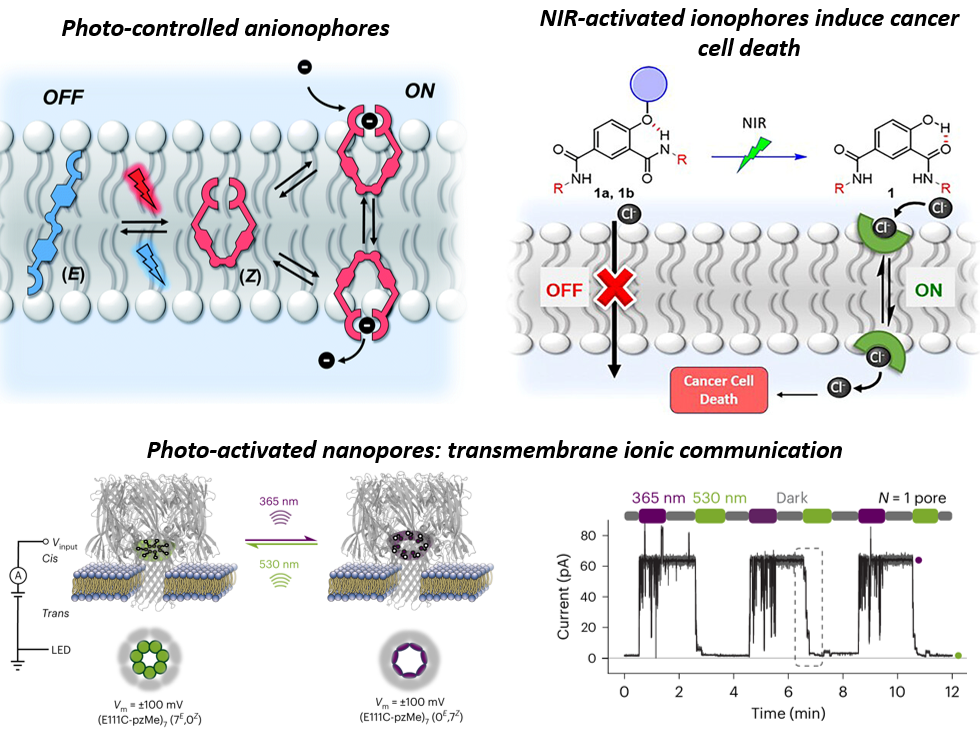
We are designing systems in which application of an external trigger (light, redox, enzymes) is used to switch on ion transport across a membrane, which is critical for targeted applications (e.g. to activate ion transport with spatiotemporal precision). For example, we have developed a post-synthetic modification strategy to access a range of multi-stimuli responsive ionophores that operate via a hydrogen bond switch mechanism (Angew. Chem. Int. Ed., 2024), or via controlled mobility in the membrane (Chem. Sci., 2022). We have also made extensive use of molecular photoswitches to develop reversibly photo-controlled systems (Chem. Sci., 2020). In collaboration with Hagan Bayley and Yujia Qing, we have incorporated molecular photoswitches into protein nanopores to develop methods for optical control of transmembrane ionic communication (Nat. Nanotech., 2025). - Halogen and chalcogen bonding anionophores
We are exploiting unconventional intermolecular interactions, such as those based on sigma-hole interactions (including halogen and chalcogen bonding), to develop highly active and selective chloride transporters (Chem. Eur. J., 2025), and redox-regulated ionophores (JACS, 2023). - Therapeutic ionophores
The development of targeted ionophores for therapeutic applications requires bio-compatible stimuli. To this end, we have recently reported a near-IR activated ionophore that acts as a photodynamic therapy for cancer (Angew. Chem., 2026).
Selected Publications
1. Near-Infrared Triggered Anion Transport Induces Cancer Cell Death
M. Ahmad, R. M. Devereux, A. J. Russell, and M. J. Langton*, Angew. Chem. Int. Ed., 2026, 65, e23734
2. Chloride Selective, Non-Protonophoric Ion Transport with Macrocyclic Halogen Bonding Anionophores
M. Flerin, F. Duarte*, and M. J. Langton*, Chem. Eur. J., 2025, 31, e202502033
3. ON-OFF Nanopores for Optical Control of Transmembrane Ionic Communication
X. Wang, A. Kerckhoffs, J. Riexinger, M. Cornall, M. J. Langton*, H. Bayley*, and Y. Qing*, Nat. Nanotechnol., 2025, 20, 432-440
4. Multistate Redox-Switchable Ion Transport Using Chalcogen-Bonding Anionophores
A. Docker, T. G. Johnson, H. Kuhn, Z. Zhang, and M. J. Langton*, J. Am. Chem. Soc., 2023, 145, 2661-2668
5. Responsive Anionophores with AND Logic Multi-Stimuli Activation
M. Ahmad, T. G. Johnson, M. Flerin, F. Duarte, and M. J. Langton*, Angew. Chem. Int. Ed., 2024, 63, e202403314 ("Hot" paper)
6. Controlling Transmembrane Ion Transport via Photo-Regulated Carrier Mobility
L. E. Bickerton and M. J. Langton*, Chem. Sci., 2022, 13, 9531-9536 ("Hot" Article)
7. Reversible Photo-Control over Transmembrane Anion Transport Using Visible-Light Responsive Supramolecular Carriers
A.Kerckhoffs and M. J. Langton, Chem. Sci., 2020, 11, 6325-6331